
Offline Generative Synthetic Data Platform for Tactical Threat Detection
The Challenge
Deploying robust computer vision on the modern battlefield requires massive volumes of highly accurate, labeled training data, but gathering real-world imagery for rare, high-value, or emerging "novel threats" presents a severe operational bottleneck. Military data is inherently scarce, heavily restricted, or entirely unavailable. Traditional data acquisition and manual annotation are agonizingly slow, while off-the-shelf, open-source generative models lack the specialized training needed to recognize defense-specific assets. Theta Vision and consortium partner MonkeyProof Solutions engineered a portable offline-native generative pipeline to ensure secure tactical deployments. The system synthesizes high-fidelity threat data on demand to bypass data scarcity while strictly maintaining secure operational boundaries.
The Solution
To eliminate this data friction and dramatically accelerate field readiness, the consortium developed "ImageGen Studio," an automated, secure synthetic data generation and model-training toolbox. Engineered to operate completely offline on portable server hardware, the system allows military operators to define new threats via simple text prompts or low-quality reference images. This breakthrough solution won the Dutch Ministry of Defence's Purple Nectar challenge, securing a €160k award to advance its development. By automatically placing generated objects into diverse scenes and instantly deriving flawless ground-truth tracking data, the pipeline removes all manual overhead. It delivers an end-to-end environment where teams can move from a raw description of an emerging threat to a fully trained, edge-deployable detection model in less than an hour.
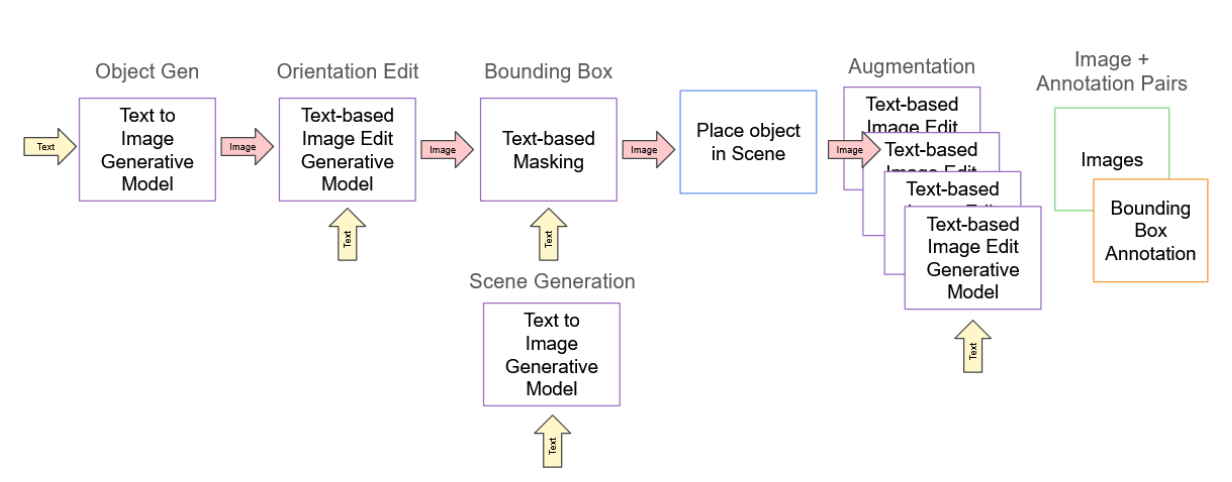
Multi-Stage Generative & Detection Pipeline
System integrity and rapid deployment are maintained through a modular architecture that seamlessly links generative AI with state-of-the-art computer vision:
Data Generation & Composition
Object Generator (QWEN-Image / Edit): Defines and refines the visual characteristics of a "novel threat" using advanced text-to-image prompts or low-quality source imagery.
Scene Generator (QWEN & GroundingSAM): Automatically generates diverse tactical backgrounds and uses segmentation to cut and paste the target object into randomized locations.
Automated Annotator: Derives 100% accurate, automated ground-truth bounding boxes from the placement step, bypassing manual labeling completely.
Adaptive Object Detection
CD-VITO Open-Set Detector: Utilizes a state-of-the-art detection head built on a frozen DINOv2 foundation model backbone. It requires only a fraction of the data compared to traditional networks to achieve exceptional classification accuracy.
Hardware-Aware Execution: Calibrated for resource-constrained, offline environments, allowing the entire pipeline to execute swiftly on a single consumer-grade GPU (such as an NVIDIA RTX 5090).
Impact
Ultimately, this project transforms tactical AI adaptation from a multi-week engineering sprint into an agile, one-hour workflow. The trained models achieve high mean Average Precision (mAP) and demonstrate remarkable generalization when validated against real-world video and drone footage. By automating the most painful, high-friction aspects of data acquisition and annotation, we insulate defense teams from data scarcity and radically compress the timeline from discovering a new threat to neutralizing it with edge-integrated AI.