
Infrastructure for Endoscopic Foundation Models
The Challenge
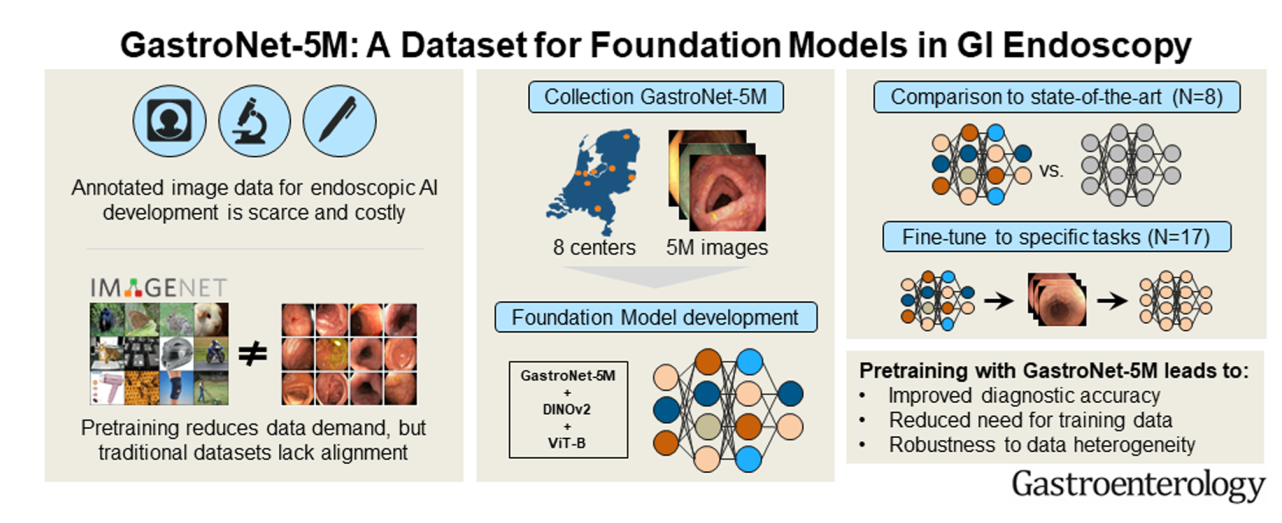
Transitioning a large-scale academic dataset into a globally accessible resource introduces significant technical friction. GastroNet-5M consists of nearly 5 million images spanning 500,000 clinical procedures across 8 hospitals. While the underlying clinical research provides immense value, moving a dataset of this magnitude out of a distributed research environment requires specialized architecture. Without a dedicated data management strategy, massive clinical image streams remain difficult to host, share, and utilize effectively for training large AI models.
The Solution
The development and clinical validation of GastroNet-5M were lead by the BONS-AI Consortium. To help transition this clinical dataset into a highly scalable asset, Theta Vision assisted with the core scientific methodology and training infrastructure setups. Recognizing that a dataset of this magnitude needs robust data management to be truly effective for the broader AI community, Theta Vision stepped in as the project's infrastructure partner.
We brought practical software engineering insights to the collaboration to bridge the gap between academic research and practical deployment. By building the underlying data management layer and deploying the dataset on our Cortex Dataset Provider platform, we provided the stable, high-performance architecture needed to handle global scientific distribution seamlessly.
Infrastructure & Data Workflow
We helped take GastroNet-5M from a multi-center research pipeline to an optimized public asset by focusing on data performance and engineering scalability:
Methodology & Training Support: Theta assisted with the core scientific methodology and training infrastructure configurations, ensuring the data pipelines were stable enough to support high-throughput model training.
Cortex Dataset Hosting: The public footprint of GastroNet-5M is securely hosted and delivered through the Theta Vision Cortex Dataset Provider infrastructure, utilizing high-speed delivery to eliminate the need for fragile cloud workarounds or physical media.
Translational Engineering Insights: Leveraging our experience in deploying computer vision systems, we provided technical insights to ensure the dataset metadata and structural organization were optimized for external software developers and research teams.
Impact
By combining clinical research with structured data engineering, GastroNet-5M has successfully transitioned from a complex, multi-center collection into an accessible resource for the global research community. AI developers worldwide can now stream and leverage GastroNet-5M directly through our Cortex ecosystem to accelerate the development of endoscopic computer vision systems. Ultimately, this partnership demonstrates how large-scale academic datasets can be successfully scaled with technical rigor and clear data provenance.